Showing posts with label Development. Show all posts

Monday, 8 September 2014

Structural Learning Week 7 - Raising Awareness of the View of Disabilities Around the World

Raising Awareness of the View of Disabilities Around the World By Vicky Quaife:

Every week a member of our team has to educate the other members of the team on a developmental issue. It’s now week 7 and we’ve had such a variety of topics and I have learnt so much through them all. This week was my week to do my ‘structural learning’ and my topic of choice is disabilities.

Definition:

When you hear the world ‘disability’ many things may come to mind, but if you are unsure of this word here is a definition to help you out:

‘A disability can be physical (such as paralysis, loss of limb, deafness), mental (such as depression or post-traumatic stress disorder) or intellectual (such as a learning disability). Some people are born disabled; others become disabled as a result of an accident or disease. Disabilities range from moderate to significant and can be temporary or permanent. With the help of a supportive community, education and vocational opportunities, disabled persons can make progress.’

Shocking Statistics:

Did you know that 1 BILLION people around the world (that’s roughly 15% of the population) are disabled? (UN)- That’s 1 in every 7 persons, or in some countries it’s as high as 1 in every 5!

And that within those 1 billion people, 80% of them live in developing countries!

20% of the world’s poorest people are disabled, and tend to be regarded in their own communities as the most disadvantaged.

1 in every 10 children has to cope with a disability around the world.

And within those children only 2-3% attends school! Imagine that- 97-98% of disabled children stay at home doing nothing every single day, never having the opportunity to learn, engage with other children, make friends. Not attending school and never learning basic skills is going to seriously impact your life as you grow older, having no education will probably mean that they will never be able to get a job.

Mortality for children with disabilities may be as high as 80 per cent in countries where under-five mortality as a whole has decreased below 20 per cent, says the United Kingdom's Department for International Development.


Also please bear in mind that these statistics are widely underestimated as in many communities people with a disability are shunned, isolated or stigmatized against, so are often left out of census reports, or families hide their children away.

It is also important to remember that these issues are not only occurring in developing countries. In the UK 75% of companies of the FTSE 100 Index on the London Stock Exchange do not meet basic levels of web accessibility, thus missing out on more than $147 million in revenue.

Only 45 countries in the world have some sort of anti-discrimination and other disability-specific-laws.

These two videos sum up a little bit about what persons with a disability rights are and how they can and should be able to exercise them! 


If you would like to see where I found my statistics then please have a look at these two websites.

My Passion:

I first started to become passionate about the rights and welfare of people with a disability when I started placements at university. I studied Occupational Therapy and during my placements I would be working with people who had physical disabilities, mental health problems and long term illnesses that resulted in some sort of disablement for that person. During my final placement I was working with adults who had a learning disability; through these placements I was able to see first-hand how important therapies such as occupational therapy, physiotherapy, and speech and language therapy can really dramatically change and enhance people’s lives.

This video is just a little cheesy summary of occupational therapy just so you all know, and it gives a few nice examples of how it can change peoples’ lives. 

Impacts:

For many children, the presence of an impairment leads to rejection or isolation from experiences that are part of normal development. This situation may be exacerbated by faulty family and community attitudes and behaviour during the critical years when children's personalities and self-images are developing.

However existing knowledge and skills could prevent the onset of many impairments and disabilities, could assist affected people in overcoming or minimizing their disabilities, and could enable nations to remove barriers which exclude disabled persons from everyday life. As I believe that actually people who have certain disabilities wouldn’t necessarily have to live a different life if it wasn’t for the environment and society creating barriers for them. If all our roads and streets were perfectly smooth a blind man could easily adapt to his environment and would be able to live a relatively normal and fulfilling life.

The issue is that in many countries, resources are not sufficient to detect and prevent disabilities and cannot meet the need for rehabilitation and supportive services of the disabled population. This is where we come in. The Millennium Development Goals (MDG’s) are a set of 8 goals created by the United Nations Development Programme (UNDP) which set out to:

  1. Eradicate extreme poverty and hunger
  2. Achieve universal primary education
  3. Promote gender equality and empower women
  4. Reduce child mortality
  5. Improve maternal health
  6. Combat HIV/AIDs, malaria and other diseases
  7. Ensure environmental sustainability
  8. Develop a global partnership for development


These goals are great and are really inspirational and are planned to be completed by 2015. However what’s missing?

15% of the population is missing. Although disabled people count for around 10-15% of the world’s population the MDGs still do not include persons with a disability.

The “END EXCLUSION – Let’s Enable the Millennium Development Goals” project sets out to change attitudes so that persons with disabilities are not denied their human rights because of discrimination. They especially want to make sure that persons with disabilities are included in programmes designed to reduce poverty, which is often not the case.

This video explains about the ‘Say Yes’ to inclusion campaign, which is backed by the European Union. 


Friday, 5 September 2014

Rwanda's Development - An Outsider's Perspective

Rwanda's Development - An Outsider's Perspective By Beth Milburn:

Rwanda is what most people would call 'a developing country'. However, when I say Rwanda is a developing country I really mean Rwanda is a developing country! You can't miss the evidence that this is a country experiencing rapid development, it's everywhere. Before I came I was not expecting to see it so clearly and I have found it extremely encouraging to see and to be here at this significant stage of Rwanda's history.

Currently Rwanda is one of the fastest developing countries in the world - ranked 9th in the world (The Economist, 2013). It experienced an economic growth rate of 8% in 2012 and 7.8% in 2013. 'Vision 2020' is the Government’s strategy and vision to transform Rwanda into a middle income country by 2020. There have been some great successes to date. For example, between 2005 and 2011 the poverty rate decreased by 12% which means that 12 million people were lifted out of poverty (UNICEF, 2013). Rwanda is one of just ten countries to achieve universal access to antiretroviral treatment for HIV (UNDP, 2012).

The beautiful view of Kigali city
Kigali, the capital city, is a beautiful mix of skyscrapers and ordinary homes stretching across hill after hill after hill. But the skyline is rapidly changing as the city is being transformed in accordance with ‘Vision 2020’– big impressive buildings and towers are appearing and you can see current projects under construction. Not only are buildings being built but we have also seen projects laying down internet cables underground as part of a plan to give the whole country a good internet connection – essential for effective development. Roads too are constantly being built and improved and the main roads we drive around on in Kigali are of an amazing quality. All the industry in the city is being moved to a designated area and the central part of town is being transformed. And this is just Kigali.

Our teammate Sam, who is from Kigali tells us that: 'you can't recognise the country from pre 2005' and that 'Rwanda is developing so fast people come out of prison and think that they are in a different country'. Imagine that!

The people are excited about the development prospects of their country and are united. They say that 'we are all Rwandan', there is one culture, one language, and development is 'one Rwandan project'. Therefore these transformations are not just taking place in Kigali. This form of development is what’s known as ‘pro-poor growth’, where the aim is that no one will get left behind as Rwanda’s economy grows. This is due to projects such as 'One Cow Per Poor Family', the prioritisation of education for all, and an emphasis on inclusive development.

The vision for the future Kigali skyline
I am genuinely excited by the hope that lies in this country and its potential for the future. Effective policies are being put in place, poverty levels are decreasing, and here development is far more tangible and evident than I ever thought it could be.

External links:


Wednesday, 27 August 2014

Kimihurura Farming Cooperative

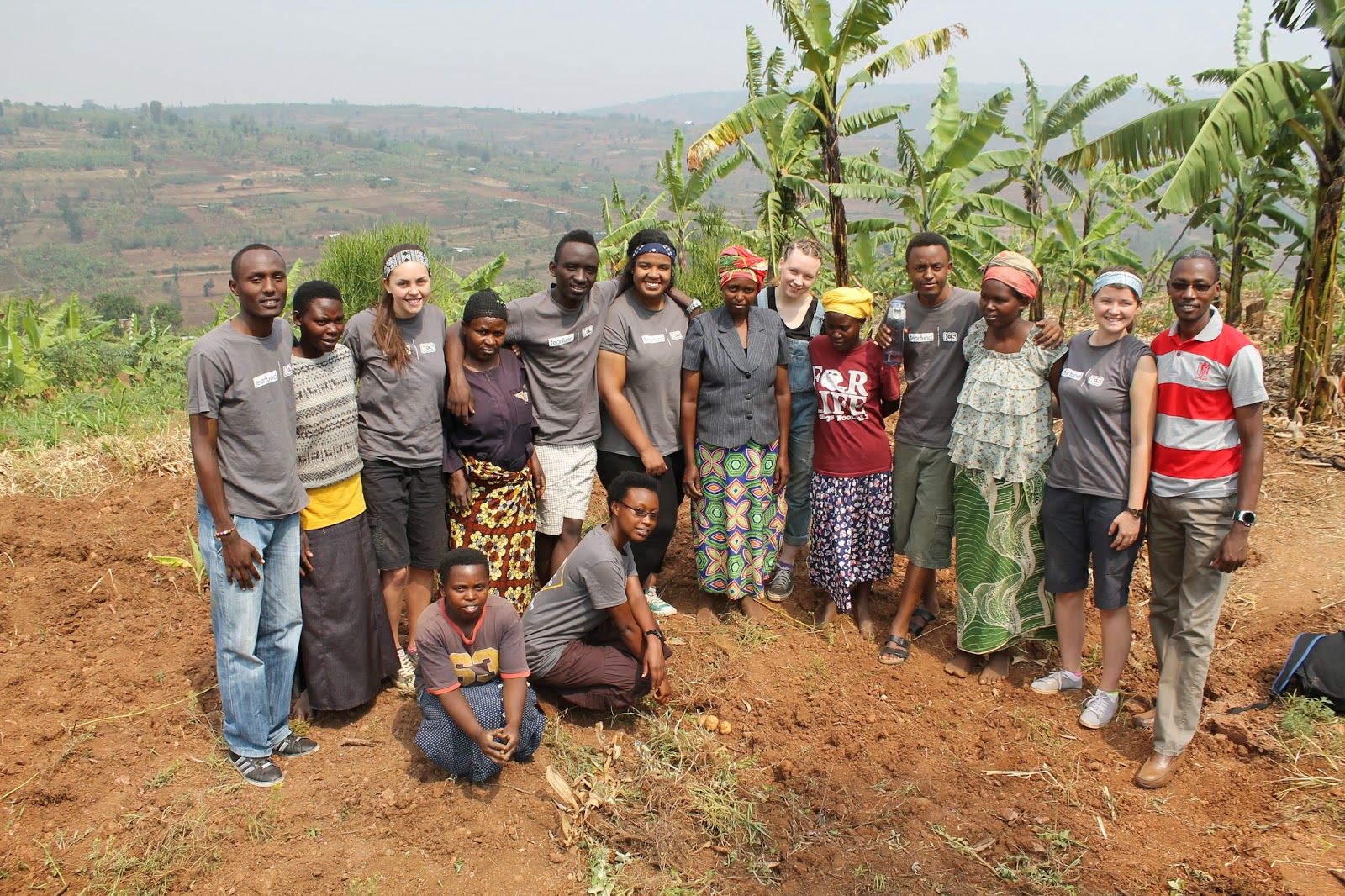
Since our very first week here at AEE we have been working at Kimihurura farming cooperative most weeks, which makes it one of our, if not, our most regular project we have been committed too.

Kimihurura farm is run by women in a local community. Some of these women are widowed and the income they earn from the farm is what they have to live off.

Rachel and Vicky watering
The majority of our time spent here is watering the crops. Although this may seem like an easy job that they could do themselves, it's the extra time that we are really giving. Whilst we are busy watering the crops, they can get on with other tasks on their agenda's such as feeding the animals or holding their team meetings with all the members of Kimihurura farming cooperative.

Henry filling up his watering can
The watering job itself can be quite tiring especially if the sun is out, as it is fairly physical as there is no hoses, so we have to continually fill our watering cans in the water holes. But we have a lot of fun together, we sing songs, and often it's a great time for us to learn more Kinyarwanda!

Chinwe, Rachel and Beth having a bit of fun!
A couple of weeks ago when we went to Kimihurura they asked us to work the land by using hoes. This was a really nice change for us from the watering we usually do. Also this gave us an opportunity to work along side two of the ladies who work on the farm. We had previously used hoes once before so we all had a fairly good technique. This meant we were much more efficient with our time and the ladies praised our efforts and work that we did!

It was particularly nice to help them with this task as one lady told us she was meant to be doing this work but was unable to due to her being pregnant! Like our previous time using the hoes, most of us managed to come away with blisters over our hands, but at the same time loving every minute of it.
Working along side two of the members of the farm
This particular project is nice for us to come back to and get stuck into physical work as all of our other regular projects are either teaching at schools or teaching English to the staff here at AEE.

It is also nice to come here as it is our only regular project that we get to work as an 8. It has been so lovely to work as an 8 and see how it helps our team to bond and have fun. In our teaching projects we always split up into groups to teach the different levels.

In summary our time spent at Kimihurura has been successful and after every session we spend at Kimihura the ladies are always very thankful of our time.

Thursday, 7 August 2014

Possibly just humour me for a minute?

So this post is slightly different, one of the members of our team - Rachel - took a while and a moment to reflect on the time that she had spent here and how it has molded and changed the outlook she initially came with.

Possibly just humour me for a minute?

I’m no expert, I’m definitely not a life saver, I’ve not even graduated from University yet, but possibly just humour me for a minute?

Last Christmas, I was a term into the first year of my Law degree and honestly I was feeling rather hard done by. I’d gone into Law with this grandiose idea that Law was about justice and helping people; and, well, from the short time I’ve spent studying it, it appears to be a lot more convoluted and complicated than that. It’s not as simple as helping the little guys, and the heroes beating the villains. So I looked elsewhere – I mean I wanted to save the world right? Don’t we all?

Through my searches I stumbled across a government programme called ICS – International Citizenship Service – whereby teams of UK volunteers aged between 18 and 25 are sent overseas to work for ten weeks with NGOs (non-governmental organisations) in international development. “Wonderful!”! I thought to myself, “Sounds absolutely perfect – this is my chance to make a difference; I’m finally going to save the world.”


So I went through the application process: the online form; the interview; the dreaded wait; the acceptance (with God’s blessing and willing); and of course the fundraising; and then I was off. Only six months after I applied, I boarded a plane from Heathrow airport bound for Rwanda, not to come back for ten weeks. Jokily I bid farewell to my friends and family, with a wave and a “Just watch me! See what I’m going to do, the world will never be the same again”.

Before leaving for Heathrow airport with Mum and Dad.
And well, I suppose you could say I was right in some senses, the world is never going to be the same again. But it’s not the entire world that’s being changed – it’s my world. Coming out to Rwanda and working with Tearfund and their partners AEE (African Evangelistic Enterprise) has made me realise that this was never about what I could do. It was never about my knowledge, my experience, and my education.

This isn’t an ‘us’ and ‘them’ situation. It can be so easy to view what is going on here as a group of volunteers who will come to a foreign place, create a whirlwind – possibly not even improving things – and then leave, having not integrated themselves into the community. But that is as far away from the reality of what this is as is possible. The most important thing I have realised since being out here, is that it is about what we can learn as a combined unit. Not about forcing our knowledge, expertise, experiences, ideals and formulas. It’s coming into a new community and environment and through this I have just as much to learn from them - if not more - than I could ever offer back in repayment.

Leading a music lesson in a catch-up school.
Never in a million years could programmes like these have been so successful without them being a joint effort. There are so many things I never dreamed of learning and it’s only been four weeks; patience (definitely lots of patience!), understanding, empathy, and compassion to name just a few things.

It’s come as a realisation that this is about humbling myself, and being respectful of what has been set in place before me. The programmes and schemes that AEE have created are beyond amazing – they are sustainable, provide the community with dignity, and create relationships. I’m not here to compete with that – I’m here to enhance that. If that’s through utilising my English communication skills, my ability to write reports , or even just my general “have-a-go” attitude , then let’s make the most of it we possibly could.

I don’t need the glory of building a house. I no longer require the satisfaction of being able to look at an area and go “That’s where I made my impact, you can see my stamp in the sand” and I definitely don’t need to save the world single handedly.

We have so much to learn, time and time again over the four weeks I have spent here, I have marvelled at how far behind we are. We look at ourselves as a ‘developed nation’ because we have the right literacy statistics, the right percentage of our population is above the poverty line, and our economy is considered advanced. But there are so many places we fall down.

When was the last time you spoke to a stranger you met in the shop? When was the last time you invited your neighbour in for a cup of tea and a talk? When was the last time you joined together as a community to improve your area? I know these were things I never did on a regular basis. I’m not pointing a finger, I’m not saying nobody ever does these things, and I definitely don’t want to preach. All I’m saying is don’t you think England, the UK, would be so much better if we all took a step back from ourselves and looked around?

Being a community unit of all ages is so important, and so beneficial.
I’ve been astonished by the sense of community, friendliness and just complete openness of the environment I’ve entered. I’ve come here as a foreigner, and let’s be honest – with milky skin like mine and a burnt red nose I stick out like a sore thumb! Yet people still greet me, they still ask how I am, and they’re interested in what we have been up to.

I might have come out to Rwanda to single handedly save the world, I may have been naïve and  optimistically unreasonable but I genuinely believe WE will save the world. It’s started with my own personal world being completely and utterly shaken up – not only have I met some of the most fantastic people of my life, who encourage me in everything I do, but I’ve learnt that I am not important. In the grand scheme of things I’m just a 19 year old Law undergraduate who is going to spend ten weeks – one summer holiday – in a developing country.

Two of the many fabulous people I have met since coming out here - Chinwe and Beth!!
But when joined together with other young people, trained professional development workers, members of the local community, a strong support system back home, and a committed charity and programme – WE really will make a difference. The difference will be made out here in Rwanda and back home in the UK. Because, we do have so much to learn whether we like it or not, nobody and nowhere is perfect.


So I guess what I’m trying to say is this:  I’ve gone from being a rather frustrated undergraduate who felt she’d been promised a world that was fair and just – to a girl who knows what she has to do, what she has to learn, how to make a difference, not as an individual but as a team, a unit, a collective. And I think if maybe, just maybe we all took 15 minutes of our time to ask that person in the supermarket, or our neighbour round for a coffee, or spent one night a month in the local food bank; we really would change our world, starting from home and working outwards. Who knows what we could all achieve? 

Wednesday, 6 August 2014

Picture of the Day 06/08/2014

Today some of our team went to a holiday camp and ran lessons in drama, whilst others stayed behind to do administrative work in the AEE office.
Some of the children playing 'heads down, thumbs up!'

Monday, 4 August 2014

Picture of the Day 04/08/2014

Today we visited a project supported by Compassion - we hope to be going there on a Monday and Wednesday after to interact with the pupils there!
Chinwe leading an ice breaker session - name, age, favourite animal/dance move and an interesting fact.

Structural Learning Week 2 - The Significance of ICT in Development

The Significance of ICT in Development by David Karemera:

This is the second in our series of eight structural learning sessions. This week it was given to us by our team leader David and he chose to do it on the importance of ICT in development - specifically how it can aid in education. Focusing and highlighting the 'One Laptop per Child' campaign that is currently happening in Rwanda.

David began the session by giving us an overview about the different aspects of ICT and the general applications and roles that it plays in everyday life...

ICT in Day-to-Day Life:

"ICT (Information and Communications Technology) is an umbrella term  that includes any communication device or application, encompassing: radio, television, cellular phones, computer and network hardware and software, satellite systems and so on, as well as the various services and applications associated with them, such as videoconferencing and distance learning." 
Chandler, Daniel, Munday, Rod” Information Technology

What are the applications of ICT?

ICT can be a great tool for development. For example in the last 10 years these technologies have become commonplace...
  • Personal Computers
  • Mobile Phones
  • Internet and Online Shopping
  • Email and Social Networks
  • Television


ICT has integrated to become part of all of our daily lives without us even noticing just how many aspects it impacts. The discoveries and invention have improved the speed of communication and help man fulfill his needs.

It has changed all aspects of live, but in-particular it has had a massive impact on education.

David then went on to highlight how ICT is used in education and how it has positively improved the way in which people learn. Further how this can be used in development to improve the lives of many more...

Use of ICT in the Classroom:
  • Students use ICT as a resource - they use computers to browse through research for projects, as well as preparing projects to present and computer programs to enhance learning.
  • Teachers use ICT as a research tool to help them to prepare lessons. They also use it as a way to communicate with other teachers through online forums and online conferences in order to compare and establish the best teaching techniques.
  • School administrators use ICT in the running of the school - to make sure that everything goes smoothly and to be able to have a pupils details and records at a click of a button.

Following this David spoke about how ICT is being used as a development tool in Rwandan primary schools by introducing us to the 'One Laptop per Child' campaign...

The 'One Laptop per Child' Campaign:


This video has been taken from the Worldfocus youtube page -  it was originally posted 5 years ago. However I feel that it still gives a great overview of what the project aims to complete as well as the massive changes it had already made in just the space of a few months!

The 'One Laptop per Child' campaign focuses at getting a laptop to every child who is of primary age in Rwanda. This project empowers the children and those around them by connecting them to the world outside and enhancing the ways in which they can learn. By the children learning the knowledge gets passed on to those around them in the community having an ever flourishing improvement.

Many of these children had never touched a computer before this project and now they are learning so fast - sometimes even faster than the teachers! 

The computers are of a simple design however this has been used to an advantage and a focus on educational studies has been established. The children use them to enhance their English, Geography and Science through a series of programs installed on the devices.

Not only have these laptops given the children a new way to learn, they have also created a new love of learning and a motivation to go to school.

Children with their new laptops - taken from telegraph.co.uk

This campaign has seen so many beneficial impacts throughout Rwanda and these will only continue to grow as more and more children get laptops.

It is clear that ICT can be used as a really effective tool for development and through the use of ICT the future will be a better and brighter place.

To find out more about this campaign go to Ministry of Education Rwanda - OLPC

Picture of the Day 03/08/2014

We led a Sunday school class where we were teaching the children the story of 'Joseph The Dreamer' complete with a set of actions to help them remember the importance and significance of this Bible story.
Children from Sunday school performing the action for Joseph, from the Bible story 'Joseph The Dreamer'.

Saturday, 2 August 2014

Umuganda - Saturday 26th July 2014

Last Saturday our entire team took part in something called UMUGANDA. This is something that happens once a month on a Saturday throughout Rwanda, whereby on a Saturday morning the whole community comes out so work on projects such as building houses and roads.

Our team was helping members of the local community level out a road that was only 2-3 minutes away from where we are living. We did this by gathering up plastic bags and litter, in order to use hoes, pickaxes and spades to raise one side of the road.


Members of the local community working on the road.
To gather a better understanding of what Umuganda is about we asked one of our In Country Volunteers (ICVs) to write us a paragraph summing up the aims and purposes of it.

Our team leader David told us...

The word UMUGANDA can be translated as 'coming together in common purpose to achieve an outcome' In traditional Rwandan culture a member of the community would call upon their family, friends and neighbours to help them to complete a difficult task.

As parts of the efforts to reconstruct Rwanda and nurture a shared national identity, the Government of Rwanda drew upon these aspects of traditional Rwandan culture and their practices in order to enrich and adapt it's development programmes to match the countries needs. The result is a set of home grown solutions - culturally owned practices translated and transformed into sustainable development programmes. Umuganda is an example of one such home grown solution.

Modern day Umuganda can be described as community work. On the last Saturday of each month, the members of the community come together to do various public works. This often includes infrastructure development and environmental protection. The tasks can be anything from mending potholes, fixing erosion and even building houses for vulnerable members of the community. Rwandans aged between 18 and 65 are obliged to participate in Umuganda and expatriates living in Rwanda are encouraged to take part.

It typical begins at 8am when the community meet to start the work, after the work has been completed a public meeting follows where they discuss national and local issues.

Getting to know members of the community!
As Umuganda happens once a month, our team is going to be lucky enough to experience it for a second time just before we leave to go back to our homes in the UK and across Rwanda. This was an amazing experience and a fantastic example of community work and how joining together as a team can get jobs done.  If felt like such an achievement to be able to walk past the road in the days following knowing that we contributed to it - even if in just a small way.

We cannot wait to see what project we will be working on next in Umuganda!!

To find out more about Umuganda go to www.rwandapedia.rw.


Tuesday, 22 July 2014

Picture of the Day 21/07/2014

The IBYRURUNGIRO (Hope) Savings and Loans group set up by AEE aims to promote sustainable business through a process of teaching their members about savings and business techniques.

Anne Marie - at the meeting of the IBYIRINGIRO self-help group set up by AEE

Friday, 18 July 2014

Picture of the Day 18/07/2014

"Before being supported by AEE our children were malnourished and suffering diseases due to malnutrition, but after being supported by AEE they are now in good health... I do not know what malnutrition is due to AEE"

Members of the co-operative working hard to prepare the tomatoes in their five green houses.

SSF/HIV Project

We visited the SSF/HIV Project on the 16th and 17th of July 2014 with the coordinator from AEE.

The SSF/HIV Project - funded by the Global Fund - works to empower the poorest members of society by training them as members of associations and providing them with livestock such as cows and goats. There are many benefits to having such livestock: milk to sell and drink, livestock to sell, manure for kitchen gardens and a rotation system whereby other members of the community get the offspring. They also share the by-products with their neighbours. Through creating such a sustainable program the success is bountiful and ever growing.

One of the members of the association having received her cow.
Across the two days we were lucky enough to meet both beneficiaries of the scheme and RUKWAVU Ethiene who is in charge of social affairs of  the Nyamiriambo sector. 

Ethiene told us that in the Nyamiriambo sector a total of 48 cows and 192 goats have been given to some of the poorest members of the community, who are living below the line of poverty. In total these have been split between 240 direct beneficiaries as they have created 12 groups each with 20 members. Moreover thanks to the expanding nature of this project there has also been numerous indirect beneficiaries throughout the community.

The project uses a rotation system whereby the offspring of the original cows and goats go to other members of the group who did not initially get those livestock, this means that in total there has been 68 cows in this sector. This will be an ever growing number and is credit to how sustainable and far reaching this project is.

Ethiene said "I am so pleased and thankful to AEE for their work, AEE are great partners of our sector, and I would like to thank AEE for their collaboration".


One of the beneficiaries with her goat.
On the first day we met some of the beneficiaries who had already received livestock, it was so inspiring to see the impact that these have had on their lives; transforming and evolving them in such a positive and forward manner. As well as progressing the community as a whole.

We met AHOBANEGEYE Esperance who received her cow in May 2013. She told us "... now I can cultivate and put manure on my crops, my cow is currently pregnant, now I drink milk and sell it for money. I have come from a bad life into a good life. I am in the Dusabane association and I am very happy to be a part of this project because it helped me to resolve many problems, my crops are now good and my cow produces 4 litres of milk a day so I can receive 1200 francs per day...".

We were also given the pleasure on the second day to see some members of 3 other groups receive their cows. Each group get between 4 or 5 cows, the allocation of which is drawn through lots, whereby the other members then receive goats.


Cows being released before they are then allocated through a series of random numbers to each beneficiary.
We were lucky enough to witness the process by which the cows are allocated to their owner. It was amazing to see the elation on their faces when they discovered which cow was going to be theirs. It was also hilarious trying to then catch the cows - which is a lot harder than you first might think!!


Members of the group waiting for their cow allocation.
Having been blessed enough to witness the success of this project through talking to previous beneficiaries, we are super excited to see it bloom through these new groups and blossom through the communities through it's direct and indirect beneficiaries.

Thursday, 17 July 2014

Picture of the Day 17/07/2014

"I couldn't get an everyday meal, but now breakfast, lunch and dinner are always available"
Eugenie is a member of TWITEZIMBERE group. With the assistance of AEE she was able to set up her own stall selling shoes in her local market.