Showing posts with label Community. Show all posts

Wednesday, 27 August 2014

Kimihurura Farming Cooperative

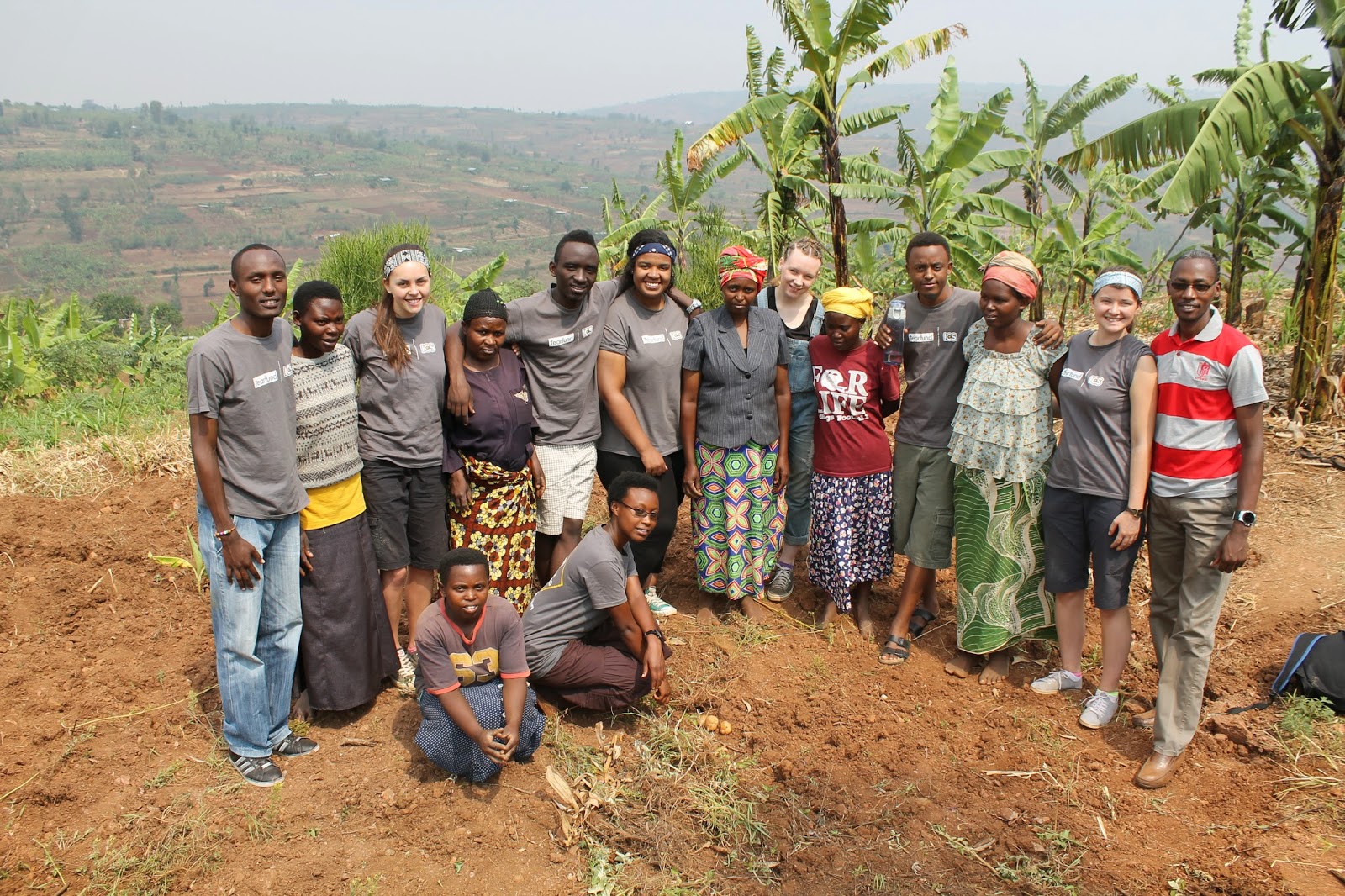
Since our very first week here at AEE we have been working at Kimihurura farming cooperative most weeks, which makes it one of our, if not, our most regular project we have been committed too.

Kimihurura farm is run by women in a local community. Some of these women are widowed and the income they earn from the farm is what they have to live off.

Rachel and Vicky watering
The majority of our time spent here is watering the crops. Although this may seem like an easy job that they could do themselves, it's the extra time that we are really giving. Whilst we are busy watering the crops, they can get on with other tasks on their agenda's such as feeding the animals or holding their team meetings with all the members of Kimihurura farming cooperative.

Henry filling up his watering can
The watering job itself can be quite tiring especially if the sun is out, as it is fairly physical as there is no hoses, so we have to continually fill our watering cans in the water holes. But we have a lot of fun together, we sing songs, and often it's a great time for us to learn more Kinyarwanda!

Chinwe, Rachel and Beth having a bit of fun!
A couple of weeks ago when we went to Kimihurura they asked us to work the land by using hoes. This was a really nice change for us from the watering we usually do. Also this gave us an opportunity to work along side two of the ladies who work on the farm. We had previously used hoes once before so we all had a fairly good technique. This meant we were much more efficient with our time and the ladies praised our efforts and work that we did!

It was particularly nice to help them with this task as one lady told us she was meant to be doing this work but was unable to due to her being pregnant! Like our previous time using the hoes, most of us managed to come away with blisters over our hands, but at the same time loving every minute of it.
Working along side two of the members of the farm
This particular project is nice for us to come back to and get stuck into physical work as all of our other regular projects are either teaching at schools or teaching English to the staff here at AEE.

It is also nice to come here as it is our only regular project that we get to work as an 8. It has been so lovely to work as an 8 and see how it helps our team to bond and have fun. In our teaching projects we always split up into groups to teach the different levels.

In summary our time spent at Kimihurura has been successful and after every session we spend at Kimihura the ladies are always very thankful of our time.

Thursday, 7 August 2014

Picture of the Day 07/08/2014

Today we went back to KIMIHURURA farm to help out with the watering, whilst having a cute little jamming sesh.
Team Kigali Family Choir - we think so!!


Saturday, 2 August 2014

Umuganda - Saturday 26th July 2014

Last Saturday our entire team took part in something called UMUGANDA. This is something that happens once a month on a Saturday throughout Rwanda, whereby on a Saturday morning the whole community comes out so work on projects such as building houses and roads.

Our team was helping members of the local community level out a road that was only 2-3 minutes away from where we are living. We did this by gathering up plastic bags and litter, in order to use hoes, pickaxes and spades to raise one side of the road.


Members of the local community working on the road.
To gather a better understanding of what Umuganda is about we asked one of our In Country Volunteers (ICVs) to write us a paragraph summing up the aims and purposes of it.

Our team leader David told us...

The word UMUGANDA can be translated as 'coming together in common purpose to achieve an outcome' In traditional Rwandan culture a member of the community would call upon their family, friends and neighbours to help them to complete a difficult task.

As parts of the efforts to reconstruct Rwanda and nurture a shared national identity, the Government of Rwanda drew upon these aspects of traditional Rwandan culture and their practices in order to enrich and adapt it's development programmes to match the countries needs. The result is a set of home grown solutions - culturally owned practices translated and transformed into sustainable development programmes. Umuganda is an example of one such home grown solution.

Modern day Umuganda can be described as community work. On the last Saturday of each month, the members of the community come together to do various public works. This often includes infrastructure development and environmental protection. The tasks can be anything from mending potholes, fixing erosion and even building houses for vulnerable members of the community. Rwandans aged between 18 and 65 are obliged to participate in Umuganda and expatriates living in Rwanda are encouraged to take part.

It typical begins at 8am when the community meet to start the work, after the work has been completed a public meeting follows where they discuss national and local issues.

Getting to know members of the community!
As Umuganda happens once a month, our team is going to be lucky enough to experience it for a second time just before we leave to go back to our homes in the UK and across Rwanda. This was an amazing experience and a fantastic example of community work and how joining together as a team can get jobs done.  If felt like such an achievement to be able to walk past the road in the days following knowing that we contributed to it - even if in just a small way.

We cannot wait to see what project we will be working on next in Umuganda!!

To find out more about Umuganda go to www.rwandapedia.rw.


Saturday, 26 July 2014

Picture of Day 26/07/2014

Saturday Morning on the 26th of July 2014 we partook in umunganda; a beautiful and inspiring community spirit and environment!!!
Joining together with members of the local community to help level out and construct a road - such an eye opening experience!

Tuesday, 22 July 2014

Picture of the Day 21/07/2014

The IBYRURUNGIRO (Hope) Savings and Loans group set up by AEE aims to promote sustainable business through a process of teaching their members about savings and business techniques.

Anne Marie - at the meeting of the IBYIRINGIRO self-help group set up by AEE

Friday, 18 July 2014

Picture of the Day 18/07/2014

"Before being supported by AEE our children were malnourished and suffering diseases due to malnutrition, but after being supported by AEE they are now in good health... I do not know what malnutrition is due to AEE"

Members of the co-operative working hard to prepare the tomatoes in their five green houses.

SSF/HIV Project

We visited the SSF/HIV Project on the 16th and 17th of July 2014 with the coordinator from AEE.

The SSF/HIV Project - funded by the Global Fund - works to empower the poorest members of society by training them as members of associations and providing them with livestock such as cows and goats. There are many benefits to having such livestock: milk to sell and drink, livestock to sell, manure for kitchen gardens and a rotation system whereby other members of the community get the offspring. They also share the by-products with their neighbours. Through creating such a sustainable program the success is bountiful and ever growing.

One of the members of the association having received her cow.
Across the two days we were lucky enough to meet both beneficiaries of the scheme and RUKWAVU Ethiene who is in charge of social affairs of  the Nyamiriambo sector. 

Ethiene told us that in the Nyamiriambo sector a total of 48 cows and 192 goats have been given to some of the poorest members of the community, who are living below the line of poverty. In total these have been split between 240 direct beneficiaries as they have created 12 groups each with 20 members. Moreover thanks to the expanding nature of this project there has also been numerous indirect beneficiaries throughout the community.

The project uses a rotation system whereby the offspring of the original cows and goats go to other members of the group who did not initially get those livestock, this means that in total there has been 68 cows in this sector. This will be an ever growing number and is credit to how sustainable and far reaching this project is.

Ethiene said "I am so pleased and thankful to AEE for their work, AEE are great partners of our sector, and I would like to thank AEE for their collaboration".


One of the beneficiaries with her goat.
On the first day we met some of the beneficiaries who had already received livestock, it was so inspiring to see the impact that these have had on their lives; transforming and evolving them in such a positive and forward manner. As well as progressing the community as a whole.

We met AHOBANEGEYE Esperance who received her cow in May 2013. She told us "... now I can cultivate and put manure on my crops, my cow is currently pregnant, now I drink milk and sell it for money. I have come from a bad life into a good life. I am in the Dusabane association and I am very happy to be a part of this project because it helped me to resolve many problems, my crops are now good and my cow produces 4 litres of milk a day so I can receive 1200 francs per day...".

We were also given the pleasure on the second day to see some members of 3 other groups receive their cows. Each group get between 4 or 5 cows, the allocation of which is drawn through lots, whereby the other members then receive goats.


Cows being released before they are then allocated through a series of random numbers to each beneficiary.
We were lucky enough to witness the process by which the cows are allocated to their owner. It was amazing to see the elation on their faces when they discovered which cow was going to be theirs. It was also hilarious trying to then catch the cows - which is a lot harder than you first might think!!


Members of the group waiting for their cow allocation.
Having been blessed enough to witness the success of this project through talking to previous beneficiaries, we are super excited to see it bloom through these new groups and blossom through the communities through it's direct and indirect beneficiaries.